
Call for small-retreat submissions for publication

Today I’m embarking on a book project with The Taunton Press. I’ll be writing about appealing, small retreats – backyard and beyond. The featured retreats will be in the U.S. or Canada and will each be less than 750 square feet. They may include such uses as: an artist studio, beach pad, bunk house, pool cabana, tea house, writer’s shack, dining pavilion, summerhouse, garden folly, mountain escape, tree house, etc… Some will be antique retreats, some will be adapted from other uses, and some will be more recently created. I aim to illuminate how they collectively portray eight characteristics of good, small-retreat design, so readers can create their own special places.

If you know of a project that you think I should consider including in the book, please let me know. For now, simply email me (Katie@katiehutchison.com) some low resolution jpegs of the exterior, interior, and context, along with some background information about what it is, where it is, who owns it, who designed it, and if it has been professionally photographed. Also, please let me know if you’re aware of any architectural drawings that depict it and its site.

I’ll be collecting projects to consider for publication in the coming weeks and look forward to reviewing those that you may recommend. Together we can create an inspiring and informative book. Please join me.

by Katie Hutchison for the House Enthusiast
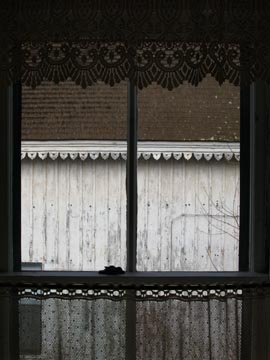
Design snapshot: Celebrating the edge

Click on this photo to see it in the note cards/prints gallery.A lace, scalloped-edge valance echoes a unique, scalloped-edge eave on a board-and-batten barn. Ornamentation along an eave or window head can embellish such lines of transition, calling attention to them. Here, both the lace valance and carved eave detail enlist daylight as an accomplice. The partial transparency of the lace softens the window head, while, in bright sun, the shadow-line of the eave carving would highlight the intersection of the roof and wall. Accents such as these enhance edge conditions.

by Katie Hutchison for the House Enthusiast
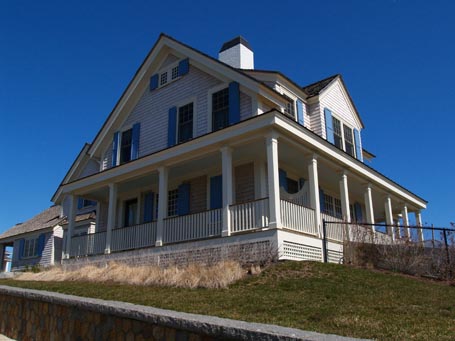
Design snapshot: A purist shudders over shutters

dssshutters.jpgThere’s a lot to like about this house: the porch, massing, materials, palette, chimney, etc. But there’s one repeated element that doesn’t always ring true, the shutters. To be authentic, they need to be plausible. If closed, they should completely cover the opening that they serve. So, if they’re used in pairs, each should be wide enough to cover half of an opening. If only a single shutter serves an opening, it should either be the full opening width or unfold from a bifold to become the full opening width. The shutters on the little gable-top windows look like they’ve been sized appropriately. The single shutters on the double-hung windows below and to the right don’t pass the smell test. The closed pair on the first floor demonstrates how they all should work. If you’re going to use shutters, the sizing may seem like a small detail, but it’s worth getting right.

by Katie Hutchison for the House Enthusiast

Design snapshot: The art of the stone wall

Click on this photo to see it in the note cards/prints gallery.This casually stacked old, field-stone wall ambles across a classic New England farm demarcating fields. The stone selection and placement appears somewhat ad hoc, but beautifully so. Gaps, between smaller rocks toward the top of this jumble and larger rocks beneath them, let daylight penetrate the upper courses, almost cheerfully defying the mass of the wall. It lumbers along performing its function while inspiring awe. It reflects an artful intervention of human will on a weighty natural material. The appeal is almost visceral. For more insight into the art of working with stone take a look at Dan Snow’s In the Company of Stone and Lew French’s Stone by Design.

by Katie Hutchison for the House Enthusiast

Birth of Cool: California Art, Design, and Culture at Midcentury

At the Addison Gallery of American Art until April 13, 2008

Where have I been? I only discovered the Addison Gallery at Phillips Academy in Andover, Mass. a couple of weeks ago. According to their website, it was established in 1931 as an “academic museum dedicated to collecting American Art.” It boasts a collection of 16,000 works, including 6000 photographs, some by Walker Evans. Apparently he was an Andover alum. Who knew? Not me.

It was the “Birth of Cool” exhibit that brought me to the museum for the first time. The exhibit title was borrowed from a 1957 Miles Davis jazz album by the same name. The featured work spans many media: painting, music, animation, architecture, photography, and furniture. The introductory signage announces, “This exhibition takes a retrospective look at the distinctive fusion of high modernism and a ‘cool’ aesthetic that were a defining aspect of Southern California culture in the 1950’s.” It’s a fun idea for a show, exhibiting a variety of artifacts ranging from the first Barbie, to abstract “Hard-edge” paintings, to Charles and Ray Eames molded plywood chairs.

Read more