House Enthusiast in Things That Inspire

There's been fun news here at Katie Hutchison Studio.  Earlier this week the Atlanta-based blog Things That Inspire featured an interview with me in the "Inspirational Architect" series. It was an honor to be included. The response at Things That Inspire has since inspired a new, House Enthusiast, magazine category called "Readers write." This is my first "Readers write" post, which will typically invite folks to share their thoughts on residential design, much the way the readers at Things That Inspire commented on my request for small-house design input. 

Take a look at this excerpt from my Things That Inspire interview, along with a reader comment, and then add your comments:

Read more

Ask Katie: Thoughts on roofs and roof/wall-height relationships

Q: My husband and I are building a new house and are confused by roof pitches and wall heights. Does the roof pitch have a relationship to wall height?

Cathy from Hammond, LA

For having her question selected for this post, Cathy is receiving a complimentary set of KHS photo note cards.

A: Often it does. Roof slopes and the relationship of the roof to wall height (relative to the floor and ground) are critical to a successful design. Often the roof and its disposition are the most defining characteristics of a home.

roof slope 101
For the sake of discussion, let’s say there are three roof-slope categories. I consider a lower slope to be 7/12 and below. A steeper slope is 10/12 and above. A mid-range slope is everything in between. Think of roof slope in terms of rise and run. A 4/12 slope means that for every 12-inch horizontal run, the roof slope rises four inches.

Roof slope is partly a function of climate, available roofing materials, and structural considerations. The steeper the roof slope is, the easier for accumulated snow or water to slide or run off. So, wetter, snowier climates tend to have steeper roofs. Materials that perform well on a steeply sloped roof may be problematic on a roof slope below 4/12. Don’t forget that the primary role of the roof is to provide overhead protection from the elements. Roof slope can also have structural implications, with flatter roofs having different requirements than more steeply sloped roofs. Some roof/wall-height relationships can trigger other structural considerations too.

Read more

Web tour: NYT: LEED shortcomings

The New York Times discusses “green" building which really isn’t all that green. In the Sunday article Mireya Navarro writes that research by the U.S. Green Building Council, which administers the LEED (Leadership in Energy and Environmental Design) program, “suggests that a quarter of the new buildings that have been certified do not save as much energy as their designs predicted and that most do not track energy consumption once in use.” The article comments on a study the USGBC performed last year of certain buildings certified through 2006. Navarro continues, “Anecdotal information from follow-up research to that study indicated that the best-performing buildings had limited window areas and tended to be smaller.” Big surprise. Smaller buildings generally have fewer windows than larger buildings, and by the very nature of their smallness, smaller buildings are easier on the environment. It’s only common sense. I wrote about common sense green design here.

by Katie Hutchison for House Enthusiast

Design snapshot: Sliding shutter doors

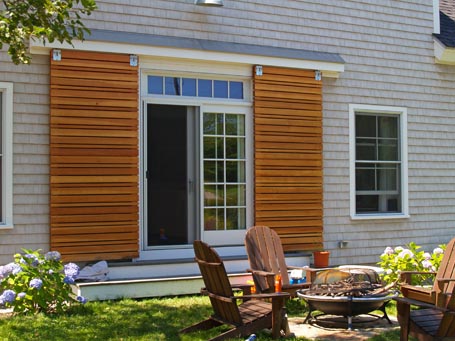
These unique, oversize, sliding doors are double-duty assets. From the inside, they provide filtered privacy when closed. From the outside, they add textural interest whether open or closed. The alternating slat dimensions help reduce their scale, and the clear finish draws attention to them as accent features. The sliding track is cleverly concealed by a shallow rooflet, which, with the help of full-width stairs, suggests a porchlet. I’m a fan of oversize, barn-type sliders and featured them in the Manchester Garage/Garden Room and wrote about them for Fine Homebuilding. Consider such sliders for breezeways and three-season rooms too.

by Katie Hutchison for House Enthusiast

Fall 2009 continuing education

Recommended multidisciplinary course and event

Expect this seminar and evening event in Cambridge, Mass. to inspire the creative process by fostering connections between disciplines.

Lesley Seminars

(Class and schedule are subject to change so check program websites for updates.)

Word and Image: Making Art in Two Languages

Instructors: Karen Davis and Cassandra Goldwater

Thursdays, September 10 – December 17, 1:00 pm – 3:50 pm

$530 (non-credit)

“Do you want to create in words and images? This class will help you develop your ideas by guiding you from planning to project completion. We will consider the work of contemporary word and image artists using a range of media, including painting, photo-based art, sculpture, and electronic, as well as a range of platforms including exhibition, the web/multi-media, books and assemblages. In-class exercises and weekly assignments will help you develop your own word and image associations, while broadening your experience with a variety of artistic approaches. The class will culminate in a presentation of projects.”

An Evening in Word and Image

Thursday, November 12, 7:00 pm - 9:00 pm

University Hall, 2nd floor, Amphitheater, Room 2-150

Free and open to the public and the Lesley community.

“Information about guest artists will be available at www.lesley.edu/ce/ls.
This unique series, sponsored by the Center for Photographic Exhibitions, New England School of Photography, and the Lesley Seminars, pairs outstanding visual artists and writers in a format that deepens our understanding of each artist's work, and creates an interplay between the artists themselves – their images and their words.”

by Katie Hutchison for House Enthusiast