Late summer/early fall 2007 special events

Recommended upcoming New England film festivals

Woods Hole Film Festival (Woods Hole, MA) July 28-August 4, 2007 www.woodsholefilmfestival.org/

Rhode Island International Film Festival (Providence, RI) August 7-12, 2007 www.film-festival.org/

Martha’s Vineyard International Film Festival (Vineyard Haven, MA) Sept. 13-16, 2007 www.mvfilmfest.com/

Newburyport Documentary Film Festival (Newburyport, MA) Sept. 28-30, 2007 www.newburyportfilmfestival.org/

Camden International Film Festival (documentary films shown in Camden, Rockport, and Rockland, ME) Sept. 27-30, 2007 www.camdenfilmfest.org/

Primer: House Garden

Intertwine house and garden so that each contributes to the other

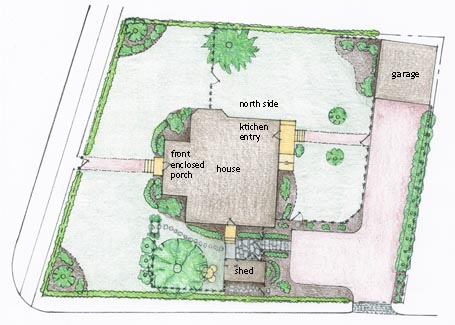
As an architect, I’m a house person, but I’m also a garden fan. What I really pine for is a house garden. My mother has one. She also has a garden house, another thing that I pine for. She has created an exquisite house garden at her village property in Connecticut. She describes it as small, a bunch of pockets, and nothing to get worked-up about, but that’s just it; it’s an imaginative series of connected, small gardens that beautifully weave between and among building elements. The pocket spaces are formed thanks to the intricate relationship between her house, her garden shed (or “summer house” as she calls it), her garage, fencing, a gateway arbor, and the surrounding streets on her privet-edged corner lot. Her gardens within those pockets are a delight in large part because of the very things that keep them small and intricate. For her, house and garden are intrinsically intertwined.housegardenplan2.jpg

The garden shed is one of the greatest enablers of my mother’s gardens. It

Read more

Ask Katie: Thoughts on an outdoor dining space

Q: I recently received a huge single plank table (probably from the late 1800’s) that would make a wonderful large outdoor dining table. I would like to construct some kind of outdoor eating space in my large yard, separate from the house, that includes some architectural elements to make it feel more permanent. Can you make any suggestions?

Katherine from Brookville, MD

A: What a dreamy project. Since your yard is large, evaluate a few possible locations for you outdoor dining space first. Is there a large tree that might provide shade or a feeling of semi-enclosure overhead? Is there a nearby outbuilding, fence, or stone wall that might help to define its borders? Is there a rock outcropping or other feature that might be incorporated into the space? Is there a particular view or approach to take into account?

Once you’ve identified the sweet spot for your dining space, you’ll want to

Read more

Design snapshot: Classical comments

Click on this photo to see it in the note cards/prints gallery.A detailed look at a wood, fluted, Roman Doric pilaster in Salem, Mass. reveals the artistry of a classical mainstay.

The shadows created in the concave, vertical flutes are an appealing contrast to the horizontal shadows below them created by the deeply profiled trim known as the “Attic base”. Evidence of the craftsman’s hand is clearly visible in the worked wood. The careful miter joint, where the trim wraps above the base plinth, reminds us that this pilaster is made of assembled parts. Their proportions are thoughtfully considered. The flutes are all wider then the space in between them, known as fillets, and together divide the surface that comprises the shaft into a three-dimensional, patterned form which otherwise, if left plain, would appear flat and dull. The profiled trim just above the base plinth gracefully enables the transition from the narrow upper shaft to the wider plinth that visually supports the pilaster.

Every element of this detail contributes to the overall elegant effect. You needn't be a classicist to appreciate it.

by Katie Hutchison for the House Enthusiast

Don't Overlook Intangible Value and Cost

Focus on long-term architectural utility not short-term dollars and cents

opinioncostvalueintro.jpg

Foremost on the minds of most homeowners about to embark on a residential project, whether it’s a renovation, addition, or new construction, is ‘How much will it cost?’ This is the loaded question that frequently stops a project in its tracks or sends it off in the wrong direction. A better question is: ‘How can value be added?’ or ‘How can intangible costs be avoided?’ Too often homeowners lose track of how a project could positively influence their lives, focusing instead on the dollars and cents spent today. Of course this happens in part because it’s easier to tally short-term financial costs than to tally long-term and non-financial costs or added value. We mustn’t overlook the intangible value that can be added to a project with one course of action, or the intangible cost of pursuing another, just because it’s difficult to measure. First we need to define our terms.

Value

For the sake of this discussion we’re concerned with two types of value: market value and utility. Market value is the easiest to quantify. It is the measure in the market place of worth. So, for example, what is the value of a tony parking space in Boston’s Back Bay? Well, apparently in November 2006 it was $250,000 according to a sale cited in the Boston Globe. Of course, it’s helpful if you and your architect are aware of the market value of the various components of your project, so you can make valuable choices.

Utility is more elusive. It’s an intangible value having to do with the usefulness or importance of something to someone. It is the key to your happiness with your project. Translating your goals and project wish list into spaces that will prove useful and important to you is the stock and trade of a good architect.

sun porch alcove

plan sketch with sun porch

plan sketch with sun porch

For example, what if you mentioned how important daylight is to you on your wish list and in response your architect designed and oriented a sun porch for you that offered a unique, quiet, get-a-way space that was partially open (with French doors and interior windows) to a larger living space? Perhaps the creation and placement of the sun porch would suggest a wrap-around shed roofline, a nearby entrance porch, an adjacency to the family room, as well as proximity to the kitchen and thus begin to shape the design of your project. Further, suppose the sun porch would add no more square footage to the project’s total anticipated square footage, just re-apportion it.

Would the sun porch have utility for you? Maybe your first instinct would be to shift its footprint and absorb it into another space, resulting possibly in more kitchen floor area. Or you might elect to spread its square footage evenly among the other rooms. But what if you stepped back and further considered that the sun porch design would provide not only abundant daylight but distinct spatial relief from the larger living spaces? Could it become your favorite sunny spot to escape with a cup of tea and the paper? What if you could you use it for multiple functions: breakfast, light office work, kids’ homework, or entertaining? How many times a week and for how long at a time do you think you might enjoy it? How might it make you feel compared to the other rooms in the house? What percentage of your leisure or work time would you spend there? Would you appreciate the differentiation of space it affords?

Now, if you were told that you couldn’t have a sun porch for some reason, how would you feel? Would you be willing to take some action, make a trade-off, in order to have a sun porch after all? The answers to these questions would begin to gauge the utility of the sun porch to you. If it is ultimately useful and important to you, it’s also an example of the kind of hidden value a thoughtful architect could create for you.

cost

Without getting too bogged down in economics, there are two primary types of project costs for us to consider: tangible monetary costs and intangible costs, both short- and long-term. The monetary costs include costs for property acquisition, infrastructure, construction, and architectural design services including building engineering. Generally a property has already been acquired or is in the process of being acquired when the idea for a project is first born, so the cost to acquire it is known, but the other monetary costs are not at first. They can be roughly estimated by researching typical cost per square foot of building area according to local contractors or building professionals and by inquiring into the services provided by local site and building professionals as well as their fee structure. Once a project enters the design process, site and building professionals in conjunction with contractors can provide a more refined sense of both short-term and long-term monetary costs associated with particular actions.

The most elusive and frequently overlooked costs though are the intangible costs that are often expressed as a design opportunity cost. For every design decision made there is a potential design opportunity cost, the cost of not pursuing an alternative. When that cost isn’t tangible, it’s difficult to quantify and has a tendency to be dismissed. It’s vital that such intangibles are evaluated.

boxy house in the middle of the lot

opinioncostvaluebox.jpg

Say you decide to build a two-story, boxy, symmetrical house parallel to the road in the middle of your flat, grassy site. You figure you’re saving in up-front excavation, construction labor, and material expenses as well as design services by making it a no-brainer. What are the intangible design opportunity costs?

  • For one, you’re probably not taking full advantage of the solar and/or natural forces on the site that can be better captured with less boxy forms and careful building orientation and placement.

  • You’re likely limiting access to daylight deep within the middle of your box due to the nature of its geometry, and you may be sacrificing privacy by bundling everything together.

  • You’re also creating a landscape of remainder spaces around your box rather than using smaller attached and detached volumes to engage the landscape creating outdoor rooms, courtyards, and secret gardens.

  • You may be missing out on celebrating or discreetly revealing a view or entrance sequence.

  • Further, a big box in the middle of a flat field will probably appear out of scale and have little relationship to the neighboring buildings.

  • The symmetrical façade, though easy to predict and construct, might feel static and result in a mismatch between window placement and room use.

  • Room size and circulation may also be controlled more by the rules of symmetry and the arbitrary box geometry than by function.

Need I go on? The intangible design opportunity costs of choosing a boxy form and locating it in the middle of your lot may be vast and far outweigh the limited up-front monetary savings that were initially assumed. Here is where a good architect can help, by illuminating potential design opportunity costs and steering you toward better alternatives.

in sum

A choice that creates value (in the sense of utility) reveals something that is important and useful to you and maximizes an otherwise unrealized opportunity. A choice that creates an intangible cost misses an opportunity and settles for far less than an opportunity’s potential. It is an architect’s pleasure to add value and advise against intangible design opportunity costs. It’s why we do what we do.

by Katie Hutchison for the House Enthusiast