
Design snapshot: Tale of two garage doors

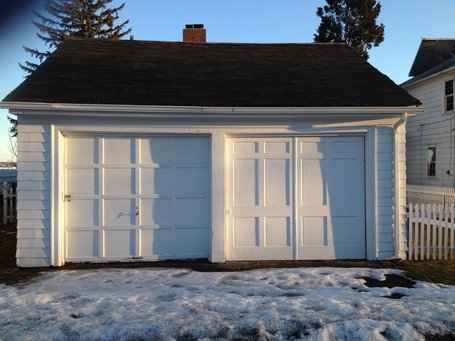
Rarely will you find a better side-by-side garage-door comparison than the one contained on this simple two-stall garage.

The left-hand door befits a typical suburban home, and the right-hand door a more rural outbuilding. Hard to know how these two doors came to be side by side, but I suspect that both openings once sported doors like those in the right-hand opening, but that the door in the left-hand opening was ultimately replaced with an updated overhead door for ease of use. 

It will come as no surprise to fellow House Enthusiasts, that in the case of informal, more rural, or more traditional outbuildings serving as garages, I'm partial to the door style -- which I would describe as carriage-style doors -- in the right-hand opening. Such doors often swing open, or in this case, slide open. Both types of operation are seen as somewhat laborious today, so many current manufacturers, such as Designer Doors, create carriage-style doors that are built in sections (like the more suburban-style door in the left-hand opening), so they, too, can open overhead for convenience.

I'd love to see a new overhead door in the left-hand opening designed to match the carriage-style doors in the right-hand opening. It would be win-win in terms of the look and function. Now if only one would materialize.

by Katie Hutchison for House Enthusiast

Q: What does the architect say? A: Program

For a home design to be successful, it must first satisfy a homeowner's program, which is the design's spatial criteria. The program often takes the form of a list, describing each desired room/use, the approximate amount of square footage assigned to each, and the relationship of each to other rooms/uses, environmental forces (like sun and breezes), and/or the site.

Think of the program as the building blocks of your home design -- whether your home will be new construction or a renovation/addition. Your program will be unique to you. It should reflect how you would like to experience your home. Edit it, and edit it again to be sure the spaces and relationships it includes are true to your lifestyle, not your parents' lifestyle, not your neighbors' lifestyle, not the imagined lifestyle of some unknown potential future buyer.

If you're drafting a program for your home project, you might want to visit the homework section of the KHS website. There, you'll find a number of questions that will challenge you to hone your program. Visit the KHS design process page to to get a sense of how your program fits into the overall design process.

by Katie Hutchison for House Enthusiast
Primer: Breezeways as connectors and destinations

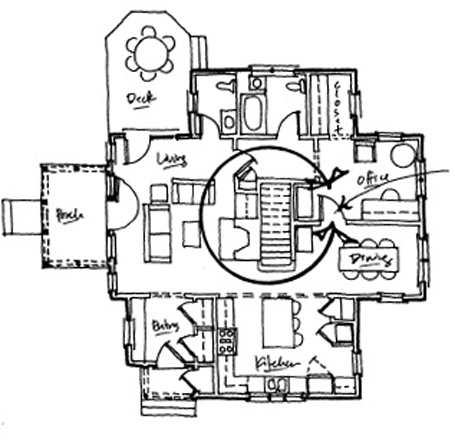
Image excerpt from my Fine Homebuilding "Drawing Board" column about breezeways. Offset breezeway example.Pick up a copy of the February/March 2014 Fine Homebuilding magazine to catch my latest "Drawing Board" contribution. This one explores designing breezeways that not only connect but serve as outdoor-living destinations.

Click here for a PDF of the column. "Three ways for breezeways" by Katie Hutchison, Issue #241, February/March 2014. Reprinted with permission copyright 2014, The Taunton Press, Inc.

Visit the KHS publications page to see other magazine columns and articles I've written.

by Katie Hutchison for House Enthusiast