Fall 2007 continuing education

Recommended New England courses about house, garden and related creative arts

(Classes and schedules are subject to change so check program websites for updates.)

Berkshire Botanical Garden

After my recent visit to tour their gardens in Stockbridge, Mass., I became curious about their classes. “The Berkshire Botanical Garden offers visitors a peaceful refuge of natural beauty, stunning display gardens, exciting community events, and informative classes for all ages and levels of skill and knowledge,” according to their website.  This one-day offering appeals to my interest in trees and shrubs as elements of architecture. See what you think.

Read more

Design snapshot: Granite gravitas

dsswitch.jpg At first, this place appears like another small park, but it's more to the observant passerby.

The two-foot-thick, dry-laid, granite stone wall gradually steps up a gentle slope, takes a short turn and then steps back down the slope, enclosing an area about the size of a small, residential, in-town lot. Bench-height, large, stone plinths cantilever out from the wall at regular intervals, 10 per long-side. Tall, skinny black locust trees planted within the courtyard dapple the light, and an enormous old maple tree, growing in-line with a row of the benches, shades some of them. It’s peaceful and contemplative, adjacent to a graveyard and a row of antique houses.

It’s the Salem Witch Trials Memorial designed by architect James Cutler and sculptor Maggie Smith of Bainbridge Island, Washington. Each bench represents one of the 20 accused and killed as a result of the witch trials in 1692. Their names, method of execution, and date of death are engraved on the lower right corner of each bench in simple, elegant, capital letters. The deep engravings cast crisp, legible shadows on the massive rough hewn stones.

At the memorial entrance a flush stone threshold is engraved with statements made by the accused, like, “I am wholly innocent of such wickedness.” Some of the quotes trail off under the weight of the stone enclosing walls, possibly signifying how their protestations were ignored. There is no signage announcing the site, just the subtle engravings.

Interestingly, the grave of Judge John Hathorn, whose witchcraft verdict led to the deaths of the accused, lies in the adjacent graveyard, Old Burying Point. Until the Memorial was built in 1992, the victims of the witch trials didn’t have tombstones of their own. Unlike conventional tombstones, these horizontal, six-inch-thick slabs of granite float improbably above the ground, a comment perhaps on the improbable deeds of which the trial victims were accused. The locust trees, it turns out, were selected for the Memorial because the majority of the witch trial victims were hung from such trees, a grisly connection.

Though the bench tombstones can invite an intimacy between a seated visitor and the deceased, sitting on the actual engraving seems disrespectful. I saw one teenager put his foot up on one. This behavioral tension is in many ways another subtle part of the design. How do we as individuals behave within a community?

This quiet memorial creates an inspired place, not just inspired objects, to honor the victims of the witch hysteria. Thankfully these stone benches will be here for years to come, challenging those who encounter them to ponder their meaning and the meaning of those 20 deaths in 1692.

by Katie Hutchison for the House Enthusiast

Berkshire Botanical Garden

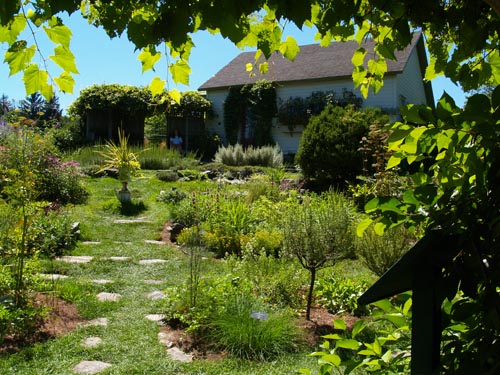
berkherb2.jpgThanks to a lead from a garden design ONLINE listing, I recently visited the Berkshire Botanical Garden to see their special event titled “Garden Ornament: Completing the Picture” which is running there through August 31, 2007. Located in Stockbridge, Mass this 15-acre property features 25, residential-scale gardens. Many include buildings in their design, which, as you can imagine, I find appealing. Oh, and yes, there are antique garden ornaments discreetly incorporated into the mix and available for sale. Most are so well placed that I fear once they’re removed/sold at the end of the show, the gardens will be somewhat bereft. They’ll need to title the next event the “Incomplete Picture”.

Meanwhile as a first-time visitor, I began my tour with the display gardens and found several to be compelling.

Read more

Design snapshot: A view with windows

dssessexbarn2.jpgI’m captivated by a beautiful barn. It’s the rhythm of the windows and doors, along with the rich red-and-white color palette, that caught my eye on this one in Essex, Mass. at Cogswell’s Grant.

The small white windows march along a little higgledy-piggledy. They’re mounted in the stables at horse-scale, meaning the horses have a great view, but my nose would only barely clear the sill. The doors in between are sized for people, of course. So both those tending the stables and their charges are represented in the architecture. This supports the theory that the best elevations express something about those within.

The little wooden visors with brackets over the windows and doors provide shade and shadow, as well as visual interest. Part of their appeal it the hint of formality that they suggest, something we don’t generally expect from an outbuilding. Such contrast is often vital to an engaging design. The large expanse of red clapboards beautifully offsets the line of dancing windows and doors, trimmed in white. The resulting elevation makes for a happy building. How lucky those horses are.

by Katie Hutchison for the House Enthusiast

DVD recommendation: Kitchen Stories

Swedish film directed by Bent Hamer

Set in the post-war 1940’s, Folke, a Swedish efficiency expert, observes the kitchen habits of Isak, a Norwegian bachelor farmer, as part of a study run by Sweden’s Home Research Institute. Malmberg, the scientist left in charge of the study, explains to his charges that the goal is to “rationalize the kitchen and the placement of the stations” to suit Norwegian bachelors. The rules of the study require that the observers live in trailers outside their subjects’ homes. They are to conduct their research (each atop a tall, pedestal chair) in their hosts’ kitchens for a period of days/weeks without interacting with their subjects. Such is the quirky premise of this delightful film.

Hamer, the director, is well aware of his audience as yet another observer in the mix, and creates a film that rewards the attentive.

Read more